
Key Takeaways
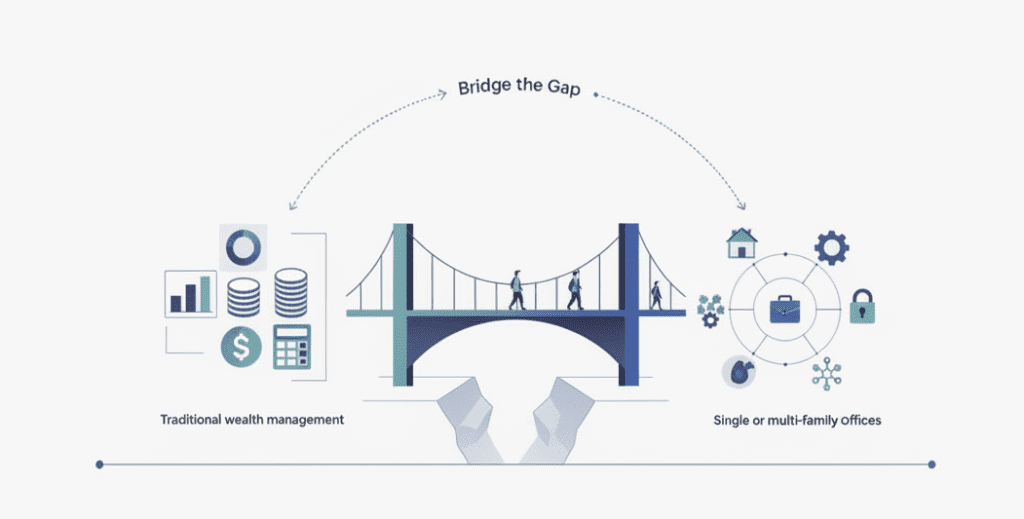
- Fractional family offices bridge the gap between traditional wealth management and single or multi family offices for founders and business owners in the 5–75M net worth range.
- Traditional wealth management models tend to be built around investment products and asset gathering, not around the complex intersection of business value, personal freedom, tax, and legacy decisions.
- The fractional family office model treats the founder’s business, personal wealth, and legacy as one system and can act as a coordination hub across CPAs, attorneys, investment managers, insurance specialists, and other advisors.
- Technology enabled reporting and governance frameworks replace ad hoc coordination, giving founders visibility, accountability, and decision discipline across their entire balance sheet.
- For owners approaching major transitions such as a sale, recapitalization, or generational transfer, a fractional family office can help reduce risk, support better decision quality, and relieve the burden of being the “offensive coordinator” of a fragmented advisory team.
Article at a Glance
Traditional wealth management was built for simpler financial lives than the ones most successful founders now lead. It assumes a world where wealth sits mainly in investment accounts, tax planning happens at year end, and estate planning is largely static. That world does not match the reality of a 5–75M founder whose majority of wealth is tied up in an operating business, possibly with multiple entities and real estate.
When advisors only see one slice of that system at a time, founders end up carrying the integration burden. They juggle input from a CPA, attorney, wealth manager, insurance agent, and sometimes a business consultant, without anyone accountable for the whole picture. The result is predictable: planning gaps, avoidable tax drag, missed opportunities, and a constant sense of “I might be missing something important.”
A fractional family office exists to address that structural problem. It brings the core disciplines of a family office down to a level that fits 5–75M founders, without the overhead of building a dedicated in-house team. The model combines business strategy, wealth planning, tax and estate coordination, and risk oversight in one system, anchored by a repeatable process rather than one-off projects.
For founders whose complexity has outgrown traditional wealth management but who do not want or need a full family office, the real question is not “Do I need more products?” It is “Do I need a better system?” This is where the fractional family office sits.
Why Traditional Wealth Management Is No Longer Enough
Traditional wealth management grew up around the idea that the main job is to invest liquid assets and periodically review performance. That structure can work for simpler situations. It breaks down as soon as most of the client’s net worth lives inside a closely held business.
The growing complexity gap
A typical founder in the 5–75M range is balancing:
- One or more operating companies with changing valuations
- Personal and business real estate
- Retirement accounts and investment portfolios
- Complex tax questions across entities and jurisdictions, and an increasing tax burden
- Estate structures that may or may not match today’s balance sheet
- Spouses, children, partners, and sometimes key employees with overlapping but not identical goals
In that environment, a model built around retirement planning, portfolio reviews and piecemeal tax moves is structurally misaligned. The deeper issues are:
- No single document or dashboard that shows the whole system in one place
- No integrated way to connect business decisions to personal Freedom Point, cash flow, and legacy planning
- No coordinating function that owns the plan across time and across advisors
Traditional advisors may be highly competent inside their domain and still collectively miss the mark because no one is responsible for the whole.
Product centric incentives and blind spots
Most traditional firms are still organized and paid to gather assets and distribute products. That creates predictable blind spots for founders:
- Advice is anchored to investable assets, not to the business where most of the value lives.
- “Planning” is often a wrapper for portfolio management rather than a true orchestration of business strategy, tax, investments, estate, and risk decisions.
- Conversations tilt toward investment or insurance products, or what the advisor is paid to implement, not what the founder most needs to decide.
Those structural incentives are hard to overcome, even for well intentioned professionals. The result is often a polished investment experience with limited or no engagement on the most important issues, maximizing enterprise value, preparing for an ideal endgame, or establishing the founder’s Freedom Point.
The hidden cost of fragmented advice
When each advisor works in a silo, the founder pays a quiet tax in the form of:
- Conflicting strategies, such as estate structures that do not adequately protect assets
- Duplicated work and fees across firms
- Missed windows to reduce taxes, prepare for transitions, restructure entities, or pre-fund long term goals
- Time lost translating one advisor’s language to another
For a founder with 5–75M in net worth, those coordination costs, tax drags, and value leaks can outweigh visible fee differences between providers.
The Structural Gap Between Advisors and Full Family Offices
On one side of the spectrum sits traditional wealth management; on the other sits the full single family or institutional multi family office. Founders in the middle often do not fit either. They’ve outgrown conventional wealth advisory models, but don’t have the time or resources to assemble their own family office.
Who traditional wealth management was built to serve
The standard wealth management model is designed to be:
- Highly scalable, with advisors handling hundreds of households
- Portfolio-centric, with planning delivered around the edges of investment work
- Focused on individuals or couples whose primary complexity sits in retirement, college, and basic tax and estate questions
This works reasonably well when:
- Most wealth is already liquid and diversified
- There is no operating business to consider
- Effective wealth transfer can be handled in basic estate plans
Founders in the 5–75M band rarely live in that world.
Why full family offices sit out of reach
A dedicated single family office, and many multi family offices, are built for a different segment entirely:
- Typical viable scale starts around nine figures of wealth.
- Annual overhead often runs into the high six or seven figures when you include staff, systems, and outside specialists.
- The service mix extends into concierge support, philanthropy infrastructure, and sometimes in-house legal and tax.
Those structures can be useful for the ultra wealthy. For a 5–75M founder, they are oversized and uneconomical. The need for integrated planning arrives long before the economics of a dedicated office make sense.
Where 5–75M founders actually sit
Founders in this “missing middle” share key characteristics:
- Complexity comparable to much larger families: concentrated wealth in enterprise value, significant tax burden, tax efficient cash flow management between entities and household, and multigenerational questions.
- Insufficient scale to justify a stand alone family office.
- Frustration with both ends of the market: traditional advisors who cannot see the whole system, and UHNW platforms where they feel like small fish.
The fractional family office model is built expressly for this band.
The Fractional Family Office Model Explained
A fractional family office is best understood as a right sized family office architecture applied across multiple founder families, with planning first approach. Products are only introduced if they provide a solution to the founder’s concerns or objectives.
What “fractional” really means
In this context, “fractional” is not a marketing adjective. It describes a structural choice:
- Senior planning talent, enterprise value expertise, and specialist networks are shared across a select group of clients rather than dedicated to one family.
- Each founder accesses a slice of a sophisticated planning platform, sized to their complexity and stage.
- The economics become viable for 5–75M founders, not just 100M plus families.
The core shift is from “one advisor and a product shelf” to “a planning hub and an integrated bench of specialists.”
The coordination hub
The defining feature of a fractional family office is the coordination hub function. It:
- Holds the integrated view of business value, personal Freedom Point, tax, investments, estate, and risk.
- Designs and maintains the plan that connects those pieces.
- Coordinates external professionals so the founder is no longer the default project manager.
This is the role most founders have been forced to play themselves. A fractional office takes it off their plate and applies institutional level discipline to it.
Scaled expertise without full time overhead
Instead of employing every specialist full time, a fractional family office typically combines:
- A core planning team that understands both enterprise value and personal wealth planning, led by a Personal CFO.
- A curated network of tax reduction, legal, risk mitigation, and investment specialists who are engaged when needed and integrated into one plan.
That structure preserves quality while avoiding the fixed cost of an in-house family office. Founders get access to specialist depth for key decisions, without paying for idle capacity between those moments.
Technology as the backbone
Modern fractional offices lean on technology to make complexity manageable:
- Consolidated dashboards that show business interests, investment accounts, real estate, and entities in a single view.
- Scenario modeling across endgame planning, deal structures, lifestyle choices, and tax pathways.
- Secure collaboration tools so external advisors work from the same information rather than their own partial files.
Technology is not the value in itself. It is the infrastructure that lets the planning system function under real world complexity.
Core Services and Capabilities Across the Whole System
A fractional family office delivers service with a different level of depth, integration, and priorities.
A different kind of service stack
Typical elements include:
- Business strategy and enterprise value
- Assessing current business market value, industry benchmarks, value gaps, and key risks.
- Business health analysis in key areas that determine marketable enterprise value.
- A value acceleration roadmap, de-risking, and eventual harvest plans with personal Freedom Point and timing.
- Wealth planning and Freedom Point
- Defining what “enough” looks like for the founder and family under different scenarios.
- Mapping lifetime cash flow pre and post transition, with an emphasis on tax efficiency.
- Tax and estate coordination
- Working alongside accountants, tax reduction specialists, estate & asset protection attorneys and wealth advisors to align structures with both the business and the personal plan.
- Anticipating how exit paths, tax strategy, distributions, and entity decisions interact with multigenerational planning.
- Risk and asset protection
- Coordinating business and personal risk conversations, with attention to catastrophic risk, liquidity, and liability exposure.
- Investment consulting
- Positioning investments as one piece of a broader strategy, not the centerpiece.
- Using open architecture platforms and avoiding product first recommendations.
The difference is not that these topics are new. It is that they are treated as one integrated system instead of a set of separate projects.
Business and personal lives treated as one system
For founders, the business is not just another asset. It is usually:
- The primary driver of net worth.
- The main source of future liquidity.
- A major part of identity and family narrative.
A fractional office acknowledges that reality and designs planning around it. Examples include:
- Modeling how a sale at different valuations and times changes Freedom Point and lifestyle risk.
- Coordinating compensation, distributions, and reinvestment in the business with personal savings and diversification.
- Aligning ownership, governance, and estate plans so the business does not become a source of conflict or unintended consequences for heirs.
Traditional wealth management rarely engages at that depth on the operating company itself.
Orchestration instead of product distribution
A fractional family office is paid to orchestrate specialists and maintain the system, not to push individual products. That changes:
- The conversation: from “which solution do you want to buy?” to “what problem are we solving and who needs to be in the room?”
- The measures of success: from short term performance to clarity, reduced regret risk, and alignment between business, freedom, and legacy.
Founders can still work with their own CPAs, attorneys, and other professionals. The difference is that someone now owns the job of pulling those threads together.
Service Depth and Coordination Across the Entire Balance Sheet
A useful way to see the difference between traditional wealth management and a fractional family office is to look at how each model handles the same domains.
Traditional wealth management vs. Fractional family office
| Area | Traditional wealth management | Fractional family office |
| Business focus | Treats business as a future source of investable assets | Treats business as primary asset to assess, protect, enhance, harvest |
| Planning scope | Portfolio centric, basic financial planning | Integrated business, personal, tax, estate, investment and risk planning |
| Advisor coordination | Ad hoc, founder led | Formal coordination, Personal CFO and tech hub owns integration |
| Endgame Planning | Only engaged post transaction | Multi year planning pre, during, and after transition |
| Reporting | Account level performance reports | System level enterprise value and net worth dashboards and scenario views |
| Fee incentives | Asset and product driven | Planning first, fee based, coordination focused |
The most important row in that table is the second: scope. Traditional models plan around assets. Fractional models plan around the founder’s whole system.
Breaking down professional silos
Founders in the 5–75M band rarely lack professionals. They lack alignment among them. A fractional family office:
- Establishes a clear planning process and cadence.
- Sets expectations with advisors about how decisions will be coordinated.
- Runs meetings where business strategy, tax, estate, and investment implications are reviewed together.
That is very different from the founder trying to relay messages between offices and hoping nothing gets lost in translation.
The facilitator function and management relief
The facilitator concept resonates because it maps to what founders are already experiencing. Many describe feeling like:
- The only person who understands the whole picture.
- The default coordinator for every initiative across business and personal planning.
- The one who has to notice planning gaps and ask for help.
In a fractional family office model, that coordination role shifts. The planning team:
- Tracks open items across business, tax, legal, investment, and risk.
- Proactively prioritize work based on risk and opportunity, not just incoming requests.
- Ensures specialists have what they need before, during, and after key decisions.
The founder still makes the decisions that matter. But the mental load and execution burden drop significantly. It’s another experienced set of eyes to make sure you don’t miss something important in your own thinking, and to bring opportunities to your attention you don’t know about today.
Governance, Decision Making, and Reporting
A sophisticated planning system is not only about ideas and expertise. It is about how decisions are made, documented, and reviewed.
Clear decision frameworks instead of ad hoc conversations
Founders are used to disciplined decision making in their companies. Their personal planning often does not enjoy the same rigor. A fractional family office brings structure to questions like:
- When should we seriously prepare for a sale or recapitalization?
- How does this year’s tax strategy interact with the long term estate and legacy plan?
- How much risk is acceptable in the business versus the portfolio, given our Freedom Point?
Frameworks and checklists do not make decisions for the founder. They make sure the right factors are considered, the right people are involved, and the tradeoffs are explicit.
Who decides versus who executes
Healthy governance draws a line between:
- Strategic authority: what the founder and family decide.
- Tactical execution: what the planning team and specialists carry out on their behalf.
In practice this can look like:
- The founder approves a transition readiness roadmap while the office coordinates valuation work, risk mapping, and tax planning conversations.
- The family setting guardrails for giving and multi-generational support while the office and attorneys design structures consistent with those guardrails.
This division mirrors how effective founders run their companies: clear ownership of key decisions, with strong execution beneath them.
Transparency and conflict handling
All advisory models involve potential conflicts of interest. A fractional office leans toward:
- Transparent, fee based planning where the founder understands what they are paying for.
- Open discussion of any situation where recommendations interact with compensation, so the founder can evaluate them with full information.
The standard is not perfection. It is clarity and alignment, backed by a planning process that keeps the client’s long term interests at the center.
Reporting and visibility that match the complexity
Traditional quarterly statements were designed for a world where most decisions revolved around portfolio performance. Founders with complex systems need more:
- Business strategy leading with enhancing enterprise value, improving metrics that drive value higher, protecting value from unexpected risks.
- Cross entity views that include companies, trusts, partnerships, and personal accounts.
- Scenario analysis showing how different exit windows, deal structures, or spending patterns change their Freedom Point and future flexibility.
- Views that focus on questions such as “Are we on track for the kind of transition and legacy we want?” rather than “Did we beat a benchmark last quarter?”
The reporting does not replace professional advice. It equips the founder and their advisors to have better conversations on real numbers instead of fragmented snapshots.
Economics and Cost Structure at Leadership Scale
When founders compare models, they often focus on visible fee percentages. The deeper question is what they are paying for and what it costs them when no one owns the whole system.
What the current model really costs
Under a traditional, fragmented setup, a founder typically pays:
- Investment management fees across one or more firms.
- Hourly or project fees to attorneys and CPAs.
- Insurance costs that may or may not be optimized.
- Their own time and energy coordinating everyone.
What does not show up on a statement:
- Tax opportunities missed because planning happened too late.
- Value left on the table at exit because the business was not prepared in time.
- Stress and stalled decisions when spouses, partners, and heirs do not share a clear plan.
That “coordination tax” is often far larger than any headline fee differential.
How fractional family offices right size overhead
A fractional office is designed to offer:
- Access to family office caliber planning and coordination at a fraction of the cost of building an internal team.
- A fee model tied to planning scope and complexity rather than only to assets under management.
- Enough capacity to engage deeply without building unnecessary infrastructure or lifestyle services that do not move the needle.
The tradeoff is straightforward: a more explicit fee for a much stronger system, versus lower visible fees with higher unmeasured leakage and risk.
What you get and what you do not
It helps to be explicit about the boundaries:
You typically get:
- An integrated planning hub that understands both enterprise value and personal wealth.
- Coordination of existing professionals rather than automatic replacement.
- Governance, reporting, and scenario work built for founder level complexity.
You typically do not get:
- Full concierge services unrelated to planning and governance.
- A replacement for your CPA or attorney’s technical authority. The office works with them.
- Promises of specific valuations, tax outcomes, or investment returns.
That focus keeps resources aimed at the areas that matter most for freedom, business value, and long term resilience.
Scenarios Where a Fractional Family Office Adds Material Value
Not every founder needs this level of system. Certain patterns are strong signals that the model will be a good fit.
Scenario 1: Founder approaching an exit in the next three to five years
Starting point:
- The business is valuable but not fully ready for due diligence scrutiny.
- There is no clear Freedom Point model showing what “enough” looks like.
- Tax and estate structures were set up years ago and have not kept pace with growth.
- The founder is getting mixed input from investment advisors, transaction professionals, and their CPA.
How a fractional family office helps:
- Runs an enterprise value path assessment to identify value gaps and risk areas before buyers do.
- Models multiple exit timing and structure scenarios against Freedom Point and lifetime cash flow.
- Coordinates tax and estate professionals to prepare for different deal types without giving individualized tax or legal advice.
- Sets a decision calendar so the founder is not forced into last minute choices under pressure.
The likely outcome is not a guaranteed higher sale price. It is a more informed, less reactive decision with fewer “if only we had…” regrets.
Scenario 2: Multi-entity, multigenerational family without a unified plan
Starting point:
- Several entities across operating companies and real estate, with overlapping ownership.
- Adult children involved in varying degrees, but no clear governance framework.
- Documents in place, but no one is confident they still match today’s wealth and goals.
How a fractional family office helps:
- Maps the current system visually so everyone can see what exists today.
- Facilitates conversations about roles, decision rights, and transition preferences.
- Coordinates legal, tax, and risk advisors around a unified plan rather than piecemeal updates.
- Builds a review cadence so the plan evolves with the family and the businesses.
The benefit is not the elimination of all conflict. It is avoiding unnecessary confusion, misalignment, and complexity driven strain.
Scenario 3: Founder feeling trapped despite outward success
Starting point:
- Net worth has grown substantially, but nearly all of it sits in the business.
- The founder cannot clearly articulate what Freedom Point is or how close they are to it.
- Existing advisors focus on investments outside the business and year end tax moves.
How a fractional family office helps:
- Defines Freedom Point in concrete terms, including lifestyle, commitments, and legacy.
- Coordinates enterprise value and personal planning so exit readiness and freedom are connected.
- Creates scenarios where the founder could step back, sell, or restructure ownership without guessing.
This is not about pushing the founder to sell. It is about replacing vague anxiety with a documented range of options.
How to Decide If a Fractional Family Office Is the Right Fit
Moving from traditional wealth management to a fractional family office is a strategic decision. A simple checklist can clarify whether it is worth exploring.
The complexity threshold
You are likely past the threshold where a more integrated model adds value if:
- Your net worth is in the 5–75M range and most of it is tied to an operating company or concentrated positions.
- You routinely spend time reconciling different advisor recommendations or repeating your story.
- You are within a few years of a potential sale, recapitalization, or major transition.
- You and your spouse or partners do not share a single, documented view of your financial life and options.
If several of these are true at once, complexity has probably outgrown what a standard model can handle well.
Questions to ask any potential provider
When evaluating a fractional family office (or any advanced planning partner), practical questions include:
- How do you integrate business strategy with personal Freedom Point and multigenerational planning?
- How do you work with my existing CPA, attorney, and other advisors?
- What does your planning cadence look like over the first year?
- How do you get paid, and how do you manage potential conflicts of interest?
- What kinds of founders are not a good fit for your model?
Clear, grounded answers to those questions are more important than polished marketing language.
A simple cost benefit lens
Instead of only comparing fee percentages, ask:
- What does our current fragmentation cost us in time, missed opportunities, and stress?
- What decisions would we make differently with a clearer, integrated view of business value, freedom, tax, and legacy?
- How much would we value the ability to show spouses, partners, and heirs a coherent plan instead of an informal mental model?
For many founders, those answers make the value of a fractional model clear.
Questions Founders Commonly Ask
What net worth typically justifies a fractional family office?
There is no hard line, but the model tends to make sense once:
- Net worth exceeds 5M, and
- Complexity includes a closely held business, multiple entities, or significant real estate, not just a single portfolio.
The driver is complexity and coordination needs more than a specific dollar figure.
Can we keep our existing CPA, attorney, and other advisors?
In most cases, yes. A fractional family office is designed to coordinate and elevate existing relationships, not replace them by default. The goal is to:
- Give your CPA and attorney a clearer strategic roadmap to execute against.
- Bring everyone into a shared planning process rather than asking each person to work in a vacuum.
If a particular relationship is not serving you, that is a separate decision.
How are investment, tax, and estate decisions actually made?
A fractional family office typically:
- Helps you define objectives and guardrails.
- Designs scenarios and frameworks with input from your specialists.
- Presents options with tradeoffs made explicit.
Final decisions remain with you. Implementation sits with the office and your tax and legal professionals, consistent with their roles and regulatory requirements.
What if our wealth and complexity eventually call for a full family office?
A fractional family office can be a bridge, not a destination. The governance, reporting, and planning systems put in place:
- Make it easier to scale into a dedicated structure later if appropriate.
- Reduce the risk of reinventing your entire planning approach in the process.
Some families remain fractional indefinitely. Others treat it as the proving ground for an eventual in house build.
How quickly will we see benefits?
Founders typically notice early changes in:
- Visibility: seeing more of the whole system in one place.
- Coordination: less time spent translating between advisors.
- Momentum: key projects moving forward instead of stalling.
Deeper benefits around exit readiness, tax strategy, and multigenerational planning build over time as the system does its work.
A Better Way to Steward Complex Wealth
For 5–75M founders, the core challenge is not a lack of options. It is a lack of integration. There is no shortage of advisors willing to help with individual pieces. The missing ingredient is a system that connects those pieces into a coherent path from complexity to freedom.
A fractional family office offers that system without requiring a 100M balance sheet or a full in-house team. It treats your business, personal wealth, and legacy as one connected story, and it takes responsibility for coordinating the professionals who support that story over time.
If your current structure leaves you acting as the offensive coordinator for a fragmented advisory bench, or if you feel successful on paper but stuck in practice, this is a moment to rethink how your wealth is being stewarded.
Two practical next steps:
- Internally, map your current advisor ecosystem and list the decisions that currently fall through the cracks between them. Use that list to clarify where coordination and governance are missing.
- Externally, schedule a clarity conversation with a fractional family office that operates with a planning led model to discuss a tailored assessment of your current advisory system, technology stack, and planning cadence. The goal is a concrete view of how a coordinated, fractional family office approach could support your specific business, wealth journey, and long term goals.
ClearPoint Family Office (CPFO) does not offer investment advice. When appropriate, CPFO may refer clients to Arlington Wealth Management (AWM), a Registered Investment Adviser with the U.S. Securities and Exchange Commission (SEC). CPFO and AWM are affiliated entities under common ownership.