Key Takeaways
- Business owners face distinctive cash‑flow planning challenges because most of their wealth is tied up in an illiquid, volatile asset they also manage day to day.
- The Freedom Point is the financial threshold where work becomes optional because reliable income sources cover your true lifestyle costs without depending on your business.
- Most owners miscalculate this threshold by underestimating lifestyle costs, overestimating business value, and ignoring taxes and business‑subsidized spending.
- Effective lifetime cash‑flow planning integrates enterprise value, personal assets, and lifestyle requirements into one system instead of treating them as separate conversations.
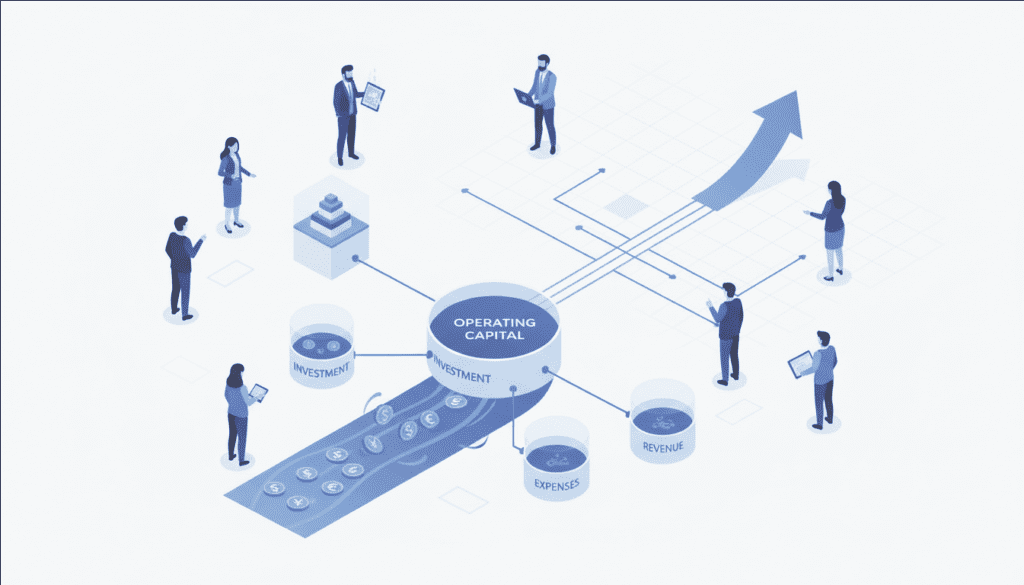
- The Lifetime Cash‑Flow Bridge Framework gives owners a practical way to connect current reality, desired future, and the strategic path between them.
- Visual, scenario‑based cash‑flow models are decision tools, not prediction machines; their value is in showing how choices today change your range of options tomorrow.
- Owners who systematically diversify personal assets, reduce guarantees, and align business strategy with Freedom Point milestones avoid the “Freedom Trap” of being rich on paper but constrained in practice.
Article at a Glance
You manage the cash flow of your business with instinctive precision: receivables, payroll, capital expenditures, debt service. Yet when the conversation shifts to your personal financial future, the picture usually gets foggy. You know the business has value and you may even know your current net worth, but you cannot clearly answer “When am I financially free, and what needs to happen between now and then?”
That gap is not about sophistication or discipline. It is structural. Traditional financial planning was built for employees with steady paychecks and diversified portfolios, not for founders whose wealth, income, and risk all orbit a single operating company. The result is a planning system that slices your life into compartments instead of recognizing that your business, personal finances, and family decisions are one integrated whole.
Lifetime cash‑flow planning for business owners addresses this by putting a single question at the center: at what point does your wealth reliably fund your chosen life without the business needing you every day? That answer is your Freedom Point, and everything from exit timing and capital allocation to debt strategy and family governance sits on top of it.
This article walks through a practical way to find that point, build a bridge from where you are now, and use the resulting clarity to make better business and life decisions without disappearing into spreadsheets or theoretical models.
The Business Owner’s Cash‑Flow Dilemma
Why Success Does Not Automatically Feel Like Freedom
On paper, many owners look successful: strong revenue, solid margins, meaningful equity value. Yet they still feel trapped. The business demands constant attention, and personal financial decisions never feel entirely safe.
Common reasons:
- The business typically represents most of your net worth and is illiquid.
- Income is lumpy and heavily tied to performance, not a predictable paycheck.
- Many personal expenses flow through the business, hiding your true lifestyle cost.
- No one has shown you how to translate enterprise value into sustainable personal cash flow.
This is where the “Freedom Trap” appears: as the business grows, your responsibilities and complexity can grow faster than your sense of personal security.
Unique Financial Challenges Owners Face
Compared with salaried executives, owners must navigate:
- Volatile income that makes traditional budgeting unreliable.
- Business and personal tax planning that interact in ways software rarely captures.
- Personal guarantees, cross‑collateralized loans, and contingent liabilities.
- A future exit that is both the biggest financial event and one of the hardest to model.
Questions that should be straightforward become difficult to answer:
- How much can I reasonably spend each year?
- What happens to my lifestyle if I sell at different valuations or times?
- How much of my success is locked up in the business versus personally secure?
These are system questions, not product questions. They require a framework that treats your business and personal life as one model.
Why Traditional Planning Fails Business Owners
The Enterprise Value Blind Spot
Most planning frameworks focus on portfolios, insurance, and retirement accounts. For founders, those are the supporting cast, not the main character. The missing piece is enterprise value and how it evolves over time.
Typical gaps:
- Planning tools treat business value as a single line item, not a dynamic asset with its own risk and growth profile.
- Exit scenarios, taxes, and deal structures are oversimplified or ignored.
- Reinvestment decisions are evaluated only inside the business, not against personal risk or diversification needs.
When enterprise value is treated as a black box, plans cannot answer questions like:
- “Does adding another 20 percent in revenue move me closer to or further from my Freedom Point?”
- “What exit valuation and structure would actually support my lifestyle over the long term?”
Product‑Driven Advice vs. System‑Level Strategy
A lot of advice you hear is shaped by what can be sold or implemented easily: portfolios, insurance, tax tactics. Each might have merit on its own, but when no one owns the overall system, you get a patchwork rather than a plan.
Typical conflicts:
- Aggressive diversification advice that ignores legitimate growth investments in the business.
- Tax strategies that optimize this year while making a future sale more complex and costly.
- Retirement contribution advice that conflicts with cash the company needs for critical initiatives.
The issue is not the competence of each specialist; it is the lack of a coordinator whose mandate is to connect the dots around your lifetime cash‑flow needs.
The Cost of Fragmented Advice
Most owners work with:
- A CPA focused on compliance and tax efficiency.
- A lawyer focused on contracts, liability, and estate documents.
- An investment advisor focused on portfolios.
- A banker, insurance professionals, and sometimes a business consultant.
Rarely do these professionals sit at the same table with one integrated plan. Over time, that fragmentation can lead to:
- Tax decisions that complicate future exit structures.
- Investment allocations that ignore business cash needs.
- Estate plans that do not fit succession realities.
The missing element is a unified planning hub that treats your lifetime cash‑flow plan as the central operating system and coordinates everyone else around it.
Hidden System Risks Inside Owner Cash‑Flow Decisions
Inconsistent Compensation and Lifestyle Drift
Many owners oscillate between lean salaries and large distributions depending on the year. This feels flexible but creates:
- Unstable personal cash‑flow patterns that confuse budgeting.
- Difficulty funding retirement or outside investments consistently.
- Psychological spending habits that expand in good years and rarely contract.
A more deliberate compensation design, where a base level is stable and variable elements are structured, creates a foundation for more durable planning.
Personal Guarantees and Invisible Liabilities
Personal guarantees rarely show up on a personal balance sheet, but they are real. They mean:
- Business problems can jump the fence and threaten personal assets.
- Your perceived safety net may be smaller than it appears.
- Even a conservative‑seeming plan can be fragile if it ignores contingent obligations.
A serious lifetime cash‑flow plan inventories these exposures and includes a strategy for reducing or restructuring them as the business matures.
Concentration Risk in One Illiquid Asset
When most of your wealth sits in your company, you are exposed to:
- Industry disruption or regulatory changes.
- Key customer or key person risk.
- Valuation swings you cannot fully control.
Diversification for an owner is not a slogan; it is a staged process of transferring some value out of the business over time without starving it of growth capital.
Family Dynamics and Unspoken Expectations
Blurry lines between business and family finances often create:
- Conflicts over distributions, reinvestment, and lifestyle choices.
- Misaligned expectations about what the business will provide and when.
- Tension around succession, roles, and entitlement.
Good planning includes family financial governance: clear roles, communication norms, and a shared understanding of what the business is and is not expected to fund.
Defining Your Freedom Point in Practical Terms
What Freedom Really Means for an Owner
For founders, financial freedom is rarely about never working again. It is about:
- Having the option to say yes or no to work based on interest, not obligation.
- Maintaining a defined lifestyle without relying on the business to fund it.
- Funding commitments to family, causes, and future projects with confidence.
The Freedom Point is the moment where reliable, diversified income streams, not your active role in the company, cover those obligations.
The Four Critical Inputs
A practical Freedom Point calculation rests on four inputs:
Lifestyle Baseline
- Your true annual cost of living, including core expenses and the “quality‑of‑life” items that actually matter to you.
- Includes the personal equivalent of expenses currently paid by the business (healthcare, vehicles, travel, etc.).
Business Value Trajectory
- Realistic estimates of what the business is worth now and how that might change under different growth scenarios.
- Anchored in market data and deal structures common in your industry.
Conversion Efficiency
- The portion of business value you realistically keep after taxes, transaction costs, and any retained equity or earn‑outs.
- Modeled as a range, not a single optimistic figure.
Sustainable Distribution Rate
- The percentage of your invested assets that can be withdrawn annually while supporting long‑term stability given your age, risk comfort, and goals.
When these four pieces are tied together, they stop being abstract variables and become a concrete threshold you can plan toward.
Why Many Owners Miscalculate
Common errors include:
- Using aspirational valuations instead of realistic ones.
- Ignoring the tax drag on sale proceeds.
- Forgetting to replace business‑funded perks and benefits in retirement budgets.
- Assuming investment returns that look better on paper than in real life.
These missteps do not just skew the math; they create false comfort that can lead to rushed exits, underfunded lifestyles, or a forced return to work later.
Estimating Your Freedom Point Without Overcomplicating It
A simple starting approach:
- Clarify your true annual lifestyle cost.
- Multiply it by a conservative distribution factor to get an approximate portfolio target.
- Estimate the net amount you could realistically take off the table from your business today and under plausible future scenarios.
- Add in existing personal assets outside the business.
You will not get perfection, but you will get a directional answer: Am I already there? Am I halfway? Or do I need both business value growth and outside savings to close the gap?
Thinking in ranges baseline, conservative, and upside keeps you honest about uncertainty while still giving you a compass.
The Lifetime Cash‑Flow Bridge Framework
The Lifetime Cash‑Flow Bridge Framework connects three questions:
- Where am I today?
- What future do I want to fund?
- What needs to happen between now and then?
The Three Essential Components
Every meaningful owner‑level cash‑flow plan integrates:
| Component | Focus | Owner Questions It Answers |
| Income and Liquidity Sources | Business distributions, salary, investments, exits | “Where does cash actually come from, and how reliable is it?” |
| True Lifestyle Requirements | Normalized personal costs, including replaced perks | “What does it really take to fund my life long term?” |
| Business Strategy Linkage | Growth, reinvestment, exit windows and structures | “How do business decisions move me toward or away from freedom?” |
When all three are visible on one bridge, you can evaluate decisions as part of a system instead of isolated moves.
A Decision Tool, Not a Prediction Machine
Your bridge is not there to prove what will happen; it is there to show you:
- How changing exit timing alters your margin of safety.
- How different deal structures affect post‑tax proceeds and recurring income.
- How shifting distributions between lifestyle, reserves, and diversification affects your trajectory.
Thinking of the plan as a dynamic map keeps you adaptable when the world does what it always does and change occurs.
Stage One: Map Your Current Reality
The Five Data Points to Gather First
Before designing the future, you need a clear baseline. Focus on:
- Current Realistic Business Value
- Personal Net Worth Outside the Business
- Present Cash‑Flow Patterns
- Debt and Personal Guarantee Exposure
- Business Growth and Risk Profile
You do not need forensic detail; you need the handful of variables that actually drive outcomes.
Seeing Your Real Personal Spending
Normalize your lifestyle costs by adding back:
- Healthcare, vehicles, travel, and entertainment that currently run through the company.
- Professional and family expenses that are indirectly subsidized by the business.
Owners are frequently surprised by how much higher their true personal cost of living is once these are adjusted. It can be uncomfortable, but that clarity is valuable.
Mapping Hidden Vulnerabilities
Beyond the numbers, identify:
- Key person risks (especially if you are the key person).
- Customer or supplier concentration.
- Internal succession gaps.
- Family financial entanglements.
These are the fault lines where an unexpected shock can undo years of progress if they are not acknowledged and gradually addressed.
Stage Two: Design Your Ideal Future
Translating Aspirations into Numbers
Start with life, not spreadsheets:
- How do you want to spend your time across work, family, and personal pursuits?
- What commitments do you want to make to children, causes, or communities?
- What does “enough” look like in your world, not someone else’s?
Then quantify:
- Baseline lifestyle costs.
- Aspirational spending (travel, giving, projects).
- One‑time or lumpy goals (education, property, large gifts).
This becomes the financial specification for your future, not a wish list.
Planning for Multiple Future Modes
Most owners do not flip from “all in” to “completely out” overnight. You are more likely to move through modes such as:
- Active ownership and leadership.
- Reduced day‑to‑day involvement with retained equity.
- Advisory or board‑level roles.
- Full exit and a new chapter.
Each mode has different cash‑flow, risk, and time demands. Designing for these explicitly makes your plan more flexible and honest.
Stage Three: Build the Cash‑Flow Bridge
Aligning Business Strategy with Personal Goals
Once your starting point and destination are clear, you can design a bridge that connects them by aligning:
- Growth initiatives with valuation drivers, not just revenue.
- Reinvestment rates with your need for outside diversification.
- Management development with your desire to be less central to operations.
This produces a more nuanced conversation:
- “If we push for this growth target, what does that do to my exit window?”
- “If we keep reinvesting at this pace, when can I reasonably reduce guarantees?”
- “If I stay, what role do I want, and what does that mean financially?”
Decision Checkpoints and Governance Rhythm
Instead of one grand plan that sits in a drawer, build:
- Monthly monitoring of a few core metrics.
- Quarterly reviews to adjust distributions, reinvestment, and buffers.
- Annual strategy sessions that revisit business trajectory, Freedom Point progress, and family priorities.
This rhythm creates structure without unnecessary bureaucracy and keeps both business and personal decisions tied to the same set of targets.
Building Resilient Financial Buffers
Resilience comes from buffers, not forecasts:
- Adequate business cash reserves matched to your volatility.
- Personal liquidity separate from the business.
- Diversified investments that do not move in lockstep with your industry.
- Insurance and risk strategies aligned with your actual exposures.
The goal is to give yourself room to breathe when the unexpected happens so you are not forced into unfavorable business or personal decisions.
Tools and Models That Keep Planning Simple
Low‑Tech vs High‑Tech
You do not need exotic software to think clearly. In many cases, a well‑built spreadsheet that shows:
- Business value over time under different scenarios.
- Outside asset growth.
- Lifestyle costs and buffers.
can be more useful than a sophisticated model that no one understands.
A good pattern:
- Use simple, transparent tools for everyday decision‑making.
- Periodically use more advanced modeling when the stakes justify the extra effort (for example, around a potential exit, recapitalization, or major restructuring).
The Three Metrics Worth Watching Monthly
Focusing on a small set of indicators keeps you out of the weeds:
| Metric | What It Shows | Why It Matters |
| Business Value Growth Rate | How fast your core asset is appreciating | Indicates progress toward value goals and readiness for potential exits |
| Personal Diversification Ratio | Percent of net worth outside the business | Tracks reduction of concentration risk |
| Freedom Ratio | Reliable income vs. true lifestyle cost | Shows how close you are to work‑optional status |
When these move in the right direction, you have some indication that the system is working as intended.
Using Visual Models in Leadership and Family Conversations
Visuals, such as simple charts and timelines, can:
- Help family members grasp how business decisions affect their security.
- Give leadership teams context for why you push in certain strategic directions.
- Make abstract tradeoffs (now vs later, growth vs diversification) visible.
Good models use plain language and highlight relationships, not spreadsheet complexity.
Stress‑Testing for Business‑Owner Realities
Essential “What If” Scenarios
A serious lifetime cash‑flow plan should be tested against situations such as:
- Revenue drops or margin compression.
- A delayed or lower‑than‑expected exit.
- Major health or family events.
- Tax or regulatory changes affecting the business or capital gains.
The aim is not to dwell on worst cases, but to know in advance what levers you could pull and in what order.
Predefined Response Playbooks
For material shocks, decide ahead of time:
- Which business investments slow first.
- How distributions will be adjusted.
- Which personal spending categories flex.
- Under what conditions you change exit timelines.
This reduces improvisation under stress and replaces it with structured responses you agreed with yourself when you were calm and clear‑headed.
Balancing Prudence and Opportunity
Resilient plans:
- Help protect you from avoidable catastrophic outcomes.
- Still leave room to pursue upside when conditions are favorable.
Too much fear can lock you into missed opportunities. Too little attention to risk can turn you into your own biggest counterparty. The bridge you build should help guard against ruin while leaving you free to be opportunistic where you have an edge.
Connecting Business Strategy Directly to Personal Freedom
Reinvest vs Diversify: A Better Question
Owners constantly weigh:
- Extra capital into the business for growth, or
- Capital out to diversify personally.
The right answer changes over time. Early on, reinvestment may be the best risk‑adjusted return. As you move closer to your Freedom Point, the balance often tilts toward building assets that do not depend on the company.
A good test for any major reinvestment is:
- Does this shorten or extend the time to my Freedom Point, and by how much?
- Is the extra risk worth that trade‑off?
Using the Freedom Point to Evaluate Opportunities
When you know your Freedom Point and where you stand relative to it, every major opportunity can be framed in those terms:
- “If this works, how does it move my timeline?”
- “If it underperforms, what does that do to my margin of safety?”
This does not replace conventional ROI analysis; it complements it with a personal lens.
Aligning Exit Windows with Life
Instead of anchoring exit decisions on arbitrary dates or purely market‑driven factors, you can:
- Map realistic exit windows to your Freedom Point progress.
- Consider structures such as partial sales, earn‑outs, and minority recaps that move you toward freedom while preserving some upside.
- Choose roles post‑transaction that align with both financial and identity needs.
This can help you avoid waiting until physical, emotional, or market constraints make the decision for you.
Avoiding the Freedom Trap
Signs You Are Building Wealth but Not Freedom
Common warning signals:
- Your net worth keeps rising, but your personal sense of safety does not.
- Most of your lifestyle would be at risk if the business stumbled.
- You defer every diversification or de‑risking opportunity “until after the next milestone.”
- Exit or succession is always “a few years away,” regardless of progress.
These patterns suggest you are building a valuable business without building a viable bridge out of it.
Non‑Negotiable Personal Funding Priorities
One way to adjust this pattern is to define a short list of personal priorities that get funded regardless of business enthusiasm, such as:
- A minimum annual transfer to personal, non‑business investments.
- A target level of personal liquidity.
- Critical protection structures (insurance, asset protection, basic estate work).
These are not a lack of ambition; they are what allow ambition to be sustainable.
Untangling Identity from Ownership
Many founders underestimate how much their sense of self is tied to the company. If your only answer to “Who are you?” is your business title, financial freedom can feel threatening rather than attractive.
Planning for life beyond primary operating roles, through projects, relationships, board work, or second ventures, makes the idea of optionality emotionally real, not just financially modeled.
Short Scenarios Business Owners Will Recognize
Early‑Stage Owner: Growth and Security in Balance
An owner of a growing manufacturing business realizes that nearly all profits are being reinvested. The company is thriving, but personal balance sheet progress is minimal. By formalizing a rule to allocate a set percentage of annual profit to personal diversification while still funding growth, the owner slightly extends the path to complete financial independence but meaningfully reduces concentration risk.
Mid‑Stage Owner: Exit Timing and Structure
A professional services founder in her 50s receives acquisition interest. Offers vary in price, earn‑out terms, and her future role. Mapping each scenario against her Freedom Point reveals that a seemingly higher‑price deal with significant performance risk may create less personal security than a slightly lower‑headline number with more stable terms and a more defined transition. The lifetime cash‑flow model shifts the conversation from “highest check” to “best overall outcome.”
Post‑Exit Owner: Recalibrating After the Deal
A technology founder sells, feels “set,” then watches markets move, lifestyle creep, and family obligations compress what looked like a wide margin of safety. Revisiting his cash‑flow plan helps him adjust investment structure, set clear boundaries on family support, and redesign spending around priorities. The result is renewed confidence without needing to return to full‑time operating roles.
Rethinking Freedom as a Core Leadership Responsibility
Owners sometimes treat their personal financial planning as separate from their role as leaders. In reality, the two are tightly linked.
When your personal security is fragile, you are more likely to:
- Stay too long at the helm.
- Avoid necessary but risky strategic moves.
- Take deals for reasons that are more about short‑term relief than long‑term fit.
When your path to the Freedom Point is clear and actively managed, you can:
- Delegate and develop leadership with more confidence.
- Make decisions with a longer horizon and less fear.
- Choose whether to stay, sell, or shift roles from a position of strength.
Financial freedom planning is not a private side project. It is part of responsible stewardship of the business, your family, and the people who depend on both.
Taking the Next Step Toward Clarity
The shift from “I hope it works out” to “I know the path I am on” starts with a few concrete moves:
- Document your true lifestyle cost, including business‑funded perks.
- Clarify your current realistic business value and personal assets outside the company.
- Sketch a first‑pass Freedom Point range and compare it with where you stand today.
- Identify one or two non‑negotiable personal funding rules and put them in place.
From there, the real progress comes when business strategy, personal wealth planning, and family governance are all anchored to the same lifetime cash‑flow bridge.
If you want support building that bridge in a way that respects both your business realities and regulatory boundaries, consider a structured assessment of your current planning. ClearPoint Family Office can walk through your numbers, your trajectory, and your goals, then work with you and your advisory team to develop a lifetime cash‑flow and Freedom Point framework tailored to your situation.
The result is not just a better spreadsheet. It is a clearer, more confident way to run your business, make major decisions, and design the next chapter of your life.
ClearPoint Family Office (CPFO) does not offer investment advice. When appropriate, CPFO may refer clients to Arlington Wealth Management (AWM), a Registered Investment Adviser with the U.S. Securities and Exchange Commission (SEC). CPFO and AWM are affiliated entities under common ownership.